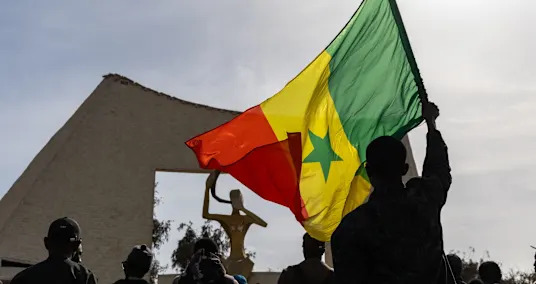
Senegal's President Bassirou Diomaye Faye has signed a new law doubling to 10 years the maximum prison term for sexual acts by same-sex couples.
The new law also criminalises the "promotion" of homosexuality, which includes any public representation and financial support by individuals or organisations, and provides for three to seven years in prison for those found guilty.
The legislation was a campaign promise of President Faye and Prime Minister Ousmane Sonko and was approved by parliament last month.
UN rights chief Volker Türk has described it as "deeply worrying", saying that the anti-LGBT legislation "flies in the face of sacrosanct human rights".
The UN official and rights groups had urged the president not to sign it into law, but the government dismissed the international criticism, arguing that the measures reflected the views of Senegalese people.
It was taken to parliament after a wave of arrests over alleged same‑sex relationships, which were already banned under Senegalese law.
In February, 12 men, including two public figures and a journalist, were arrested and charged with "acts against nature".
Campaign group Human Rights Watch has recently noted a rise in "hostility toward LGBT people", adding that MPs had twice – in 2022 and 2024 - unsuccessfully sought to raise jail terms and penalties against same-sex relationships.
The new law was passed by an overwhelming majority in the National Assembly on 11 March, with 135 MPs voting in favour, none against and three abstaining.
Several other African countries have also introduced tough new laws against the LGBTQ+ community in recent years.
In September last year, Burkina Faso's transitional parliament approved a bill banning homosexual acts, following its neighbour Mali in 2024.
In 2023, Uganda voted in some of the world's harshest anti-homosexual legislation, meaning that people engaging in same-sex relationships can be sentenced to death in certain circumstances.
Ghana is also planning to re-introduce an anti-homosexual bill that activists say threatens basic human rights, safety and freedom.
You may also be interested in:

Go to BBCAfrica.com for more news from the African continent.
Follow us on Twitter @BBCAfrica, on Facebook at BBC Africa or on Instagram at bbcafrica
BBC Africa podcasts
LATEST POSTS
- 1
 Zelensky sees new Russian attack threat from Belarus
 - 2Chief of Staff Zamir warns IDF will collapse due to lack of manpower, raises 'ten red flags'
- 3Egypt's cafés and shops forced to close early due to Iran war
- 4Artemis II astronauts race to set a new distance record from Earth and behold the moon's far side
- 5Flu surges across U.S. as doctor visits reach highest level since 1997



- Aluminum salts emerge as likely target as health officials scrutinize childhood vaccines
- 'Stranger Things' made him a heartthrob. He left Hollywood anyway.
- These Cities Led Global Jet-Setting In 2025, According To New Data
- Italian court approves extradition to Germany of Ukrainian suspect in Nord Stream pipeline blast
- I was about to film a movie with Glen Powell when my hair started falling out in clumps. Alopecia has made me unrecognizable as an actor.
- the Kinds of Thailand: Decision in favor of Your Number one Thai Dish!
- New studies of old dogs help scientists understand where they came from
- Manual for 6 Busssiness Class Flights
- Turkey key underlying issue as Israel, Greece, Cyprus hold summit